
Baby Taj, Sikandra or Fatehpur Sikri – Which One Deserves Your Time and Why?
Here's a confession most travel guides won't make: the Taj Mahal is not the only reason Agra will stay with you forever. Sure, it's the headliner—the monument that launches a thousand Instagram posts. But step just a few kilometres beyond that white marble icon, and you'll discover three Mughal masterpieces that genuinely compete for your heart. I'm talking about the Baby Taj (Tomb of Itimad-ud-Daulah), Sikandra (Akbar's Tomb), and the abandoned ghost city of Fatehpur Sikri.
After spending years helping international visitors plan their city tour of Agra by car, I've lost count of how many travellers later told me these three sites moved them more than the Taj itself. The problem? Most first-time visitors have no idea which ones to prioritise, especially when time is tight. This guide breaks down each monument honestly—the atmosphere, the history, the photography potential, and the logistics—so you can decide exactly what belongs on your itinerary.
Baby Taj – The Jewel Box on the Yamuna
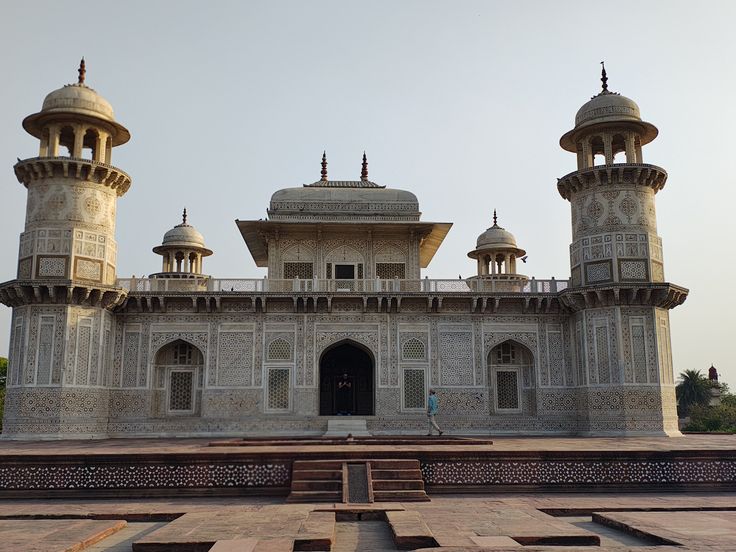
Baby Taj (Itimad-ud-Daulah) – Often called the "draft" for the Taj Mahal, this delicate marble tomb sits peacefully on the banks of the Yamuna River.
The Tomb of Itimad-ud-Daulah—universally nicknamed the Baby Taj—sits on the opposite bank of the Yamuna, about 5 kilometres from the Taj Mahal. Built between 1622 and 1628 by Empress Nur Jahan for her father, this monument is historically significant for a reason most guidebooks gloss over: it was the first Mughal structure built entirely from marble, and the first to use the pietra dura inlay technique that would later define the Taj Mahal.
Walking through the Baby Taj feels like stepping inside a jewellery box. The semi-precious stone inlays—carnelian, jasper, lapis lazuli, topaz—catch the light differently with every shift of your angle. The lattice screens (jali work) are so finely carved you'd swear they were made of lace rather than marble. It's smaller than the Taj, yes, but that intimacy is precisely its magic. You can stand inches from the wall and trace 400-year-old craftsmanship with your fingertips.
Why Choose Baby Taj?
- Crowd factor: Dramatically fewer tourists than the Taj Mahal—morning visits often feel private
- Photography: Arguably the finest close-up detail shots of any Agra monument
- Time required: 45 minutes to 1 hour is plenty
- Best paired with: Mehtab Bagh (both are on the same riverbank)
Visit the Baby Taj between 7:00 and 8:30 AM when the soft morning light illuminates the white marble with a warm glow. By mid-morning, tour buses from Delhi arrive and the peaceful atmosphere evaporates. If you arrange your sikandra and baby taj sightseeing through a reliable cab, your driver can time your arrival perfectly.
Sikandra – Akbar's Grand Farewell
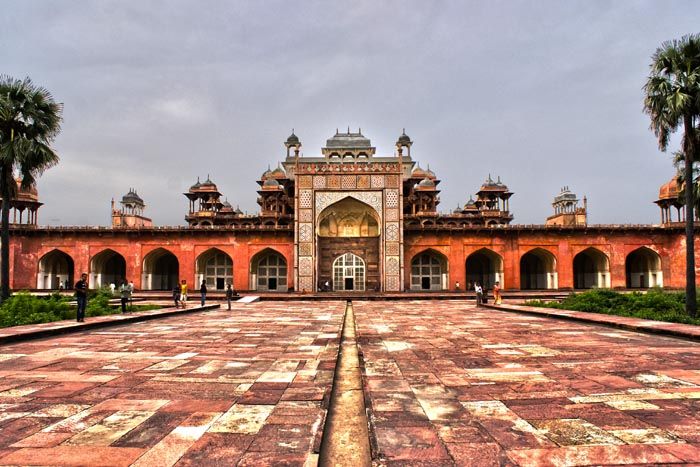
Akbar's Tomb at Sikandra – A five-storey architectural wonder set amid sprawling Mughal gardens on the outskirts of Agra city.
About 13 kilometres northwest of the Taj Mahal, on the Agra-Delhi highway, you'll find Sikandra—the final resting place of Emperor Akbar, the greatest of the Mughal rulers. Akbar actually began designing his own tomb during his lifetime (a common Mughal practice), but it was his son Jahangir who completed it in 1613.
What strikes you first at Sikandra is sheer scale. The main gateway—a colossal red sandstone structure inlaid with white marble geometric patterns—is so photogenic that many visitors mistake it for the tomb itself. Beyond it, a formal Mughal char bagh garden stretches outward, and roaming freely through the grass you'll spot langur monkeys, peacocks, and even spotted deer. It feels more like a serene national park than a cemetery.
The tomb itself is a five-storey pyramidal structure that blends Hindu, Christian, Islamic, Buddhist, and Jain architectural motifs—a deliberate reflection of Akbar's famous religious tolerance and his syncretic faith, Din-i-Ilahi. The top floor is an open marble terrace where Akbar's cenotaph sits under the open sky, a stark contrast to the enclosed chambers of most Mughal tombs.
Why Choose Sikandra?
- Historical depth: The most architecturally unique Mughal tomb in India—five distinct levels, each in a different style
- Nature + Heritage: Wild peacocks and deer inside the complex create an unexpected experience
- Crowd factor: Very few tourists, even during peak season
- Time required: 1 to 1.5 hours
The langur monkeys at Sikandra can be mischievous. Keep your water bottles, sunglasses, and any loose items secured. They're not aggressive, but they are opportunistic. Don't feed them—it's both dangerous and against the rules.
Fatehpur Sikri – The Ghost City That Still Speaks
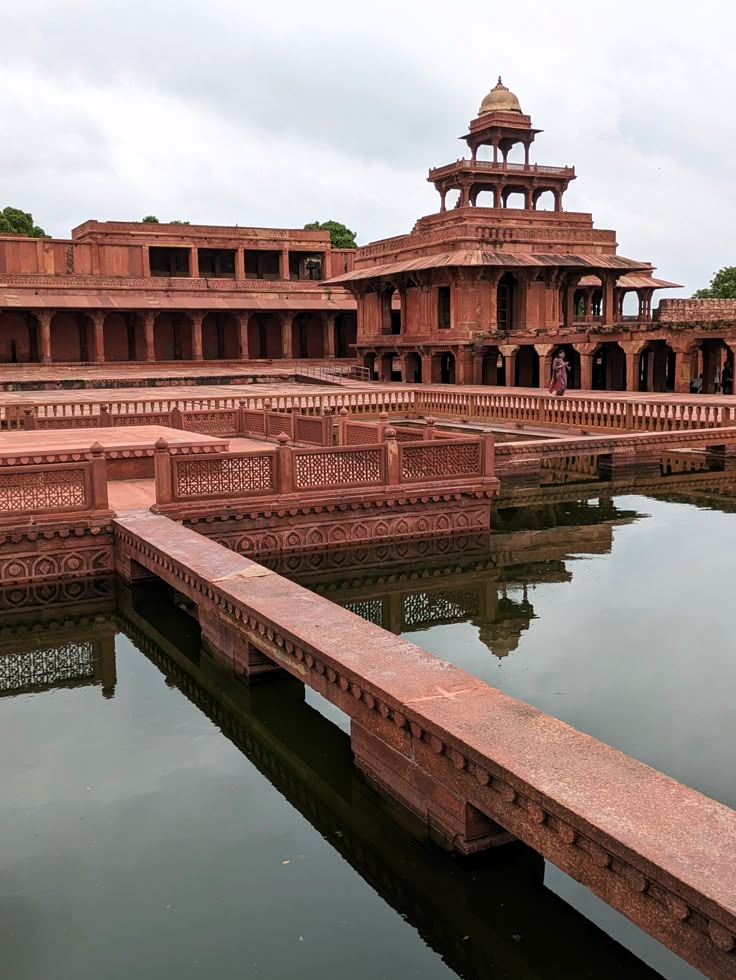
Fatehpur Sikri – Emperor Akbar's abandoned capital city, now a UNESCO World Heritage Site, standing virtually unchanged since the 16th century.
If Baby Taj is a jewel box and Sikandra is a garden of contemplation, then Fatehpur Sikri is an entire Mughal film set frozen in time. Located 37 kilometres southwest of Agra, this was Emperor Akbar's purpose-built capital city—constructed between 1571 and 1585, occupied for only 14 years, and then mysteriously abandoned, probably due to water scarcity.
Recognised as a UNESCO World Heritage Site, Fatehpur Sikri is one of the finest examples of Mughal civic planning anywhere on Earth. The Buland Darwaza (Gate of Magnificence) soars 54 metres high—it was the tallest gateway in the world when built. Inside the complex, you'll walk through the Panch Mahal, Diwan-i-Khas, Jodha Bai's Palace, and the tomb of Sufi saint Salim Chishti, whose white marble shrine glows like a pearl inside the red sandstone courtyard.
The agra to fatehpur sikri cab ride takes about 40 to 50 minutes along a well-maintained highway. It's a comfortable drive, and most Agra cab services include it as part of a full-day extended sightseeing package.
Why Choose Fatehpur Sikri?
- Scale and drama: Nothing in Agra matches the cinematic grandeur of walking through an entire abandoned Mughal city
- UNESCO status: One of India's most perfectly preserved heritage sites
- Spiritual element: The Salim Chishti Dargah is still an active place of prayer and pilgrimage
- Time required: 2 to 2.5 hours minimum (don't rush it)
Hire an ASI-approved guide at the main entrance (₹300–500 for foreigners). The stories behind each building—Akbar's legendary debates, his love story with Jodha, the chess court where he used human pieces—transform the ruins into a living narrative. Avoid the touts who approach you in the parking area; always ask for the official ID card.
Head-to-Head Comparison: Baby Taj vs Sikandra vs Fatehpur Sikri
| Feature | Baby Taj | Sikandra | Fatehpur Sikri |
|---|---|---|---|
| Distance from Taj Mahal | 5 km | 13 km | 37 km |
| Indian Ticket | ₹25 | ₹20 | ₹50 |
| Foreign Tourist Ticket | ₹310 | ₹310 | ₹610 |
| Time Needed | 45 min – 1 hr | 1 – 1.5 hrs | 2 – 2.5 hrs |
| Best For | Art & detail lovers | History buffs & nature | Architecture & adventure |
| Crowd Level | Low | Very Low | Moderate |
| Photography Rating | ★★★★★ (close-up) | ★★★★ (golden hour) | ★★★★★ (wide-angle) |
| Wheelchair Access | Partial | Good (ground level) | Difficult (steps) |
So, Which One Should You Actually Visit?
Here's my honest, no-hedging answer after years of driving travellers through this route:
If you only have time for one, pick Fatehpur Sikri. Nothing else near Agra gives you that sense of walking through a vanished empire. The scale is breathtaking, the stories are unforgettable, and the Buland Darwaza alone is worth the 40-minute drive.
If you love art and fine craftsmanship, the Baby Taj will move you in ways the main Taj Mahal sometimes doesn't, simply because you can get so close to the inlay work. It's also the quickest visit, making it easy to slot into any itinerary.
If you're a history lover who wants to understand Mughal philosophy and religious tolerance, Sikandra offers layers of meaning that few other Indian monuments can match. Plus, those peacocks strutting through the gardens? Genuinely magical.
But here's the truth most travellers discover: with a properly planned city tour of Agra by car, you don't have to choose. All three can be covered comfortably in a single day. That's exactly why having the best cab services for Agra matters—you need a driver who knows the routes, the parking situations, and the ideal sequence to beat the crowds.
The Ideal Full-Day Itinerary (Tested and Proven)
- 7:00 AM – Start at Sikandra (coolest hour, empty grounds, best light on the gateway)
- 8:30 AM – Drive to Baby Taj (soft morning light, almost no crowds)
- 10:00 AM – Optional: Taj Mahal or Agra Fort visit
- 12:30 PM – Lunch at a local restaurant (your cab driver will know the best spots)
- 1:30 PM – Drive to Fatehpur Sikri (arrive before the afternoon heat peaks)
- 4:00 PM – Return to Agra or onward to Jaipur
This itinerary is exactly what the experienced drivers at Cabs in Agra follow for their full-day sightseeing packages. The route is optimised to minimize backtracking and maximize your time at each site. You can browse their complete tour packages to find one that fits your schedule.
Why a Car Makes All the Difference
Let me be blunt: trying to cover these three sites by auto-rickshaw or shared transport is a logistical headache you don't need on holiday. Auto-rickshaws can't comfortably travel to Fatehpur Sikri, the meter negotiations are exhausting, and you'll waste hours standing by the roadside waiting for rides. Public buses exist but they're overcrowded, infrequent, and won't drop you at the monument gates.
A dedicated Agra cab service with an air-conditioned car and a knowledgeable local driver changes the entire experience. Your driver waits while you explore, suggests the best photo spots, warns you about common tourist scams, and gets you between monuments in air-conditioned comfort. For a city where summer temperatures regularly hit 45°C, that car AC isn't a luxury—it's survival.
The Archaeological Survey of India's official website lists updated entry fees and timings for all protected monuments, and it's worth checking before your trip for any holiday closures.
📋 Key Takeaways
- Fatehpur Sikri offers the most dramatic, large-scale Mughal experience and is a must-visit UNESCO site
- Baby Taj delivers unmatched artistic detail and peaceful riverbank ambiance in under an hour
- Sikandra uniquely blends nature, wildlife, and multi-faith Mughal architecture
- All three monuments can be comfortably covered in a single full-day city tour of Agra by car
- Start early (7 AM) at Sikandra, then Baby Taj, then Fatehpur Sikri for the optimal crowd-free experience
- A reliable cab with an experienced local driver is the smartest transport choice by far
- October to March is the ideal season—pleasant weather, clear skies, beautiful light
Final Thoughts
Agra's story goes far beyond a single white marble mausoleum. The Baby Taj whispers about the artisans whose hands made the Taj Mahal possible. Sikandra speaks of an emperor who dreamed of religious harmony five centuries before the world caught up. And Fatehpur Sikri stands as a haunting reminder that even the greatest empires are temporary.
Together, these three monuments don't just complement a Taj Mahal visit—they complete it. They give you the full picture of Mughal ambition, artistry, and human impermanence. And the most comfortable, efficient, and enjoyable way to experience them all? A well-planned city tour of Agra by car with a driver who knows every shortcut, every golden-hour window, and every story behind every stone.
Frequently Asked Questions
Can I visit Baby Taj, Sikandra, and Fatehpur Sikri all in one day?
Yes, absolutely. With a well-planned city tour of Agra by car, you can comfortably cover all three monuments in a single day. Start early at Sikandra around 7:00 AM, then head to Baby Taj by mid-morning, and drive to Fatehpur Sikri after lunch. A reliable cab service makes this itinerary completely stress-free.
Which monument is best for photography – Baby Taj, Sikandra, or Fatehpur Sikri?
Baby Taj wins for close-up detail shots of intricate marble inlay work. Fatehpur Sikri offers the most dramatic wide-angle compositions with its massive red sandstone courtyards. Sikandra is best during golden hour when soft light hits the geometric marble tomb. Each offers unique photographic opportunities you won't find elsewhere.
How much does a full-day Agra sightseeing cab cost?
A full-day cab covering Agra city monuments plus Fatehpur Sikri typically costs between ₹1,800 and ₹2,500 for an AC sedan. Prices may vary slightly depending on the vehicle type and season. Booking through a reputable service like Cabs in Agra ensures transparent pricing with no hidden charges.
Is Fatehpur Sikri worth the 37 km drive from Agra?
Without question, yes. Fatehpur Sikri is a UNESCO World Heritage Site and one of the best-preserved Mughal cities in the world. The 40-minute drive from Agra passes through scenic countryside, and the sheer scale of the ghost city is something photographs simply cannot capture. It is an essential stop on any complete Agra tour.
What is the best time of year to do this Agra sightseeing tour?
October through March is the ideal window. Temperatures are pleasant, skies are generally clear, and the light is gorgeous for sightseeing and photography. Avoid April through June when temperatures regularly exceed 45°C, making outdoor monument visits extremely uncomfortable.
Ready to Explore Agra Beyond the Taj?
Let Cabs in Agra plan your perfect full-day sightseeing tour with an experienced local driver, AC car, and zero hidden fees. Baby Taj, Sikandra, Fatehpur Sikri—all in one unforgettable day.
Book Full Day Agra Tour →