

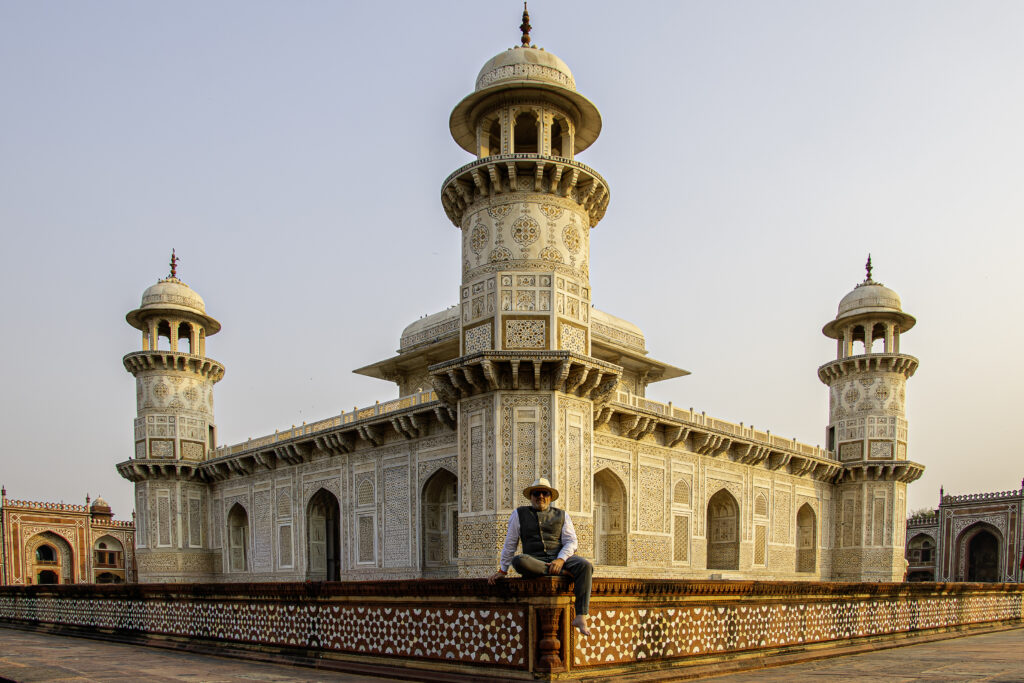
Agra Travel Guide Baby Taj, Sikandra or Fatehpur Sikri – Which One Deserves Your Time and Why? 📝 By Cabs in Agra 📅 July 2025 ⏱️ 8 min read Here’s a confession most travel guides won’t make: the Taj Mahal is not the only reason Agra will stay with you forever. Sure, it’s the headliner—the monument that launches a thousand Instagram posts. But step just a few kilometres beyond that white marble icon, and you’ll discover three Mughal masterpieces that genuinely compete for your heart. I’m talking about the Baby Taj (Tomb of Itimad-ud-Daulah), Sikandra (Akbar’s Tomb), and the abandoned ghost city of Fatehpur Sikri. After spending years helping international visitors plan their city tour of Agra by car, I’ve lost count of how many travellers later told me these three sites moved them more than the Taj itself. The problem? Most first-time visitors have no idea which ones to prioritise, especially when time is tight. This guide breaks down each monument honestly—the atmosphere, the history, the photography potential, and the logistics—so you can decide exactly what belongs on your itinerary. 🕌 3 Monuments 📍 37 km Farthest Point 🎟️ ₹310 Foreign Tourist Entry (Avg) ⏰ 6–7 hrs Total Tour Time Baby Taj – The Jewel Box on the Yamuna Baby Taj (Itimad-ud-Daulah) – Often called the “draft” for the Taj Mahal, this delicate marble tomb sits peacefully on the banks of the Yamuna River. The Tomb of Itimad-ud-Daulah—universally nicknamed the Baby Taj—sits on the opposite bank of the Yamuna, about 5 kilometres from the Taj Mahal. Built between 1622 and 1628 by Empress Nur Jahan for her father, this monument is historically significant for a reason most guidebooks gloss over: it was the first Mughal structure built entirely from marble, and the first to use the pietra dura inlay technique that would later define the Taj Mahal. Walking through the Baby Taj feels like stepping inside a jewellery box. The semi-precious stone inlays—carnelian, jasper, lapis lazuli, topaz—catch the light differently with every shift of your angle. The lattice screens (jali work) are so finely carved you’d swear they were made of lace rather than marble. It’s smaller than the Taj, yes, but that intimacy is precisely its magic. You can stand inches from the wall and trace 400-year-old craftsmanship with your fingertips. Why Choose Baby Taj? Crowd factor: Dramatically fewer tourists than the Taj Mahal—morning visits often feel private Photography: Arguably the finest close-up detail shots of any Agra monument Time required: 45 minutes to 1 hour is plenty Best paired with: Mehtab Bagh (both are on the same riverbank) Pro Tip Visit the Baby Taj between 7:00 and 8:30 AM when the soft morning light illuminates the white marble with a warm glow. By mid-morning, tour buses from Delhi arrive and the peaceful atmosphere evaporates. If you arrange your sikandra and baby taj sightseeing through a reliable cab, your driver can time your arrival perfectly. Sikandra – Akbar’s Grand Farewell Akbar’s Tomb at Sikandra – A five-storey architectural wonder set amid sprawling Mughal gardens on the outskirts of Agra city. About 13 kilometres northwest of the Taj Mahal, on the Agra-Delhi highway, you’ll find Sikandra—the final resting place of Emperor Akbar, the greatest of the Mughal rulers. Akbar actually began designing his own tomb during his lifetime (a common Mughal practice), but it was his son Jahangir who completed it in 1613. What strikes you first at Sikandra is sheer scale. The main gateway—a colossal red sandstone structure inlaid with white marble geometric patterns—is so photogenic that many visitors mistake it for the tomb itself. Beyond it, a formal Mughal char bagh garden stretches outward, and roaming freely through the grass you’ll spot langur monkeys, peacocks, and even spotted deer. It feels more like a serene national park than a cemetery. The tomb itself is a five-storey pyramidal structure that blends Hindu, Christian, Islamic, Buddhist, and Jain architectural motifs—a deliberate reflection of Akbar’s famous religious tolerance and his syncretic faith, Din-i-Ilahi. The top floor is an open marble terrace where Akbar’s cenotaph sits under the open sky, a stark contrast to the enclosed chambers of most Mughal tombs. Why Choose Sikandra? Historical depth: The most architecturally unique Mughal tomb in India—five distinct levels, each in a different style Nature + Heritage: Wild peacocks and deer inside the complex create an unexpected experience Crowd factor: Very few tourists, even during peak season Time required: 1 to 1.5 hours Important Notice The langur monkeys at Sikandra can be mischievous. Keep your water bottles, sunglasses, and any loose items secured. They’re not aggressive, but they are opportunistic. Don’t feed them—it’s both dangerous and against the rules. Fatehpur Sikri – The Ghost City That Still Speaks Fatehpur Sikri – Emperor Akbar’s abandoned capital city, now a UNESCO World Heritage Site, standing virtually unchanged since the 16th century. If Baby Taj is a jewel box and Sikandra is a garden of contemplation, then Fatehpur Sikri is an entire Mughal film set frozen in time. Located 37 kilometres southwest of Agra, this was Emperor Akbar’s purpose-built capital city—constructed between 1571 and 1585, occupied for only 14 years, and then mysteriously abandoned, probably due to water scarcity. Recognised as a UNESCO World Heritage Site, Fatehpur Sikri is one of the finest examples of Mughal civic planning anywhere on Earth. The Buland Darwaza (Gate of Magnificence) soars 54 metres high—it was the tallest gateway in the world when built. Inside the complex, you’ll walk through the Panch Mahal, Diwan-i-Khas, Jodha Bai’s Palace, and the tomb of Sufi saint Salim Chishti, whose white marble shrine glows like a pearl inside the red sandstone courtyard. The agra to fatehpur sikri cab ride takes about 40 to 50 minutes along a well-maintained highway. It’s a comfortable drive, and most Agra cab services include it as part of a full-day extended sightseeing package. Why Choose Fatehpur Sikri? Scale and drama: Nothing in Agra matches the cinematic grandeur of walking through an entire abandoned Mughal city UNESCO status: One of
The Ultimate Guide to Taj Mahal Full Moon Light Tours
Everything you need to know about tickets, night timings, weather factors, and local expert secrets.
There is nothing quite as magical, poetic, or breathtaking as witnessing the world’s ultimate symbol of love bathed in silver moonlight. Built by Mughal Emperor Shah Jahan for his beloved wife Mumtaz Mahal, the monument was designed entirely of translucent Makrana white marble. This specific marble possesses a unique property: it reflects the light of its surroundings. Under a full moon, the Taj Mahal emits a subtle, ethereal blue-silver glow that looks like a painting.
In our many years of organizing custom travel itineraries and guiding travelers through Agra's bustling streets, the number one request we receive is to arrange Taj Mahal night viewing tickets. It is widely considered one of the most romantic tourism experiences in the world.
However, because the Archaeological Survey of India (ASI) and the Supreme Court of India heavily restrict this experience to protect the monument, navigating the logistics can be an absolute nightmare for first-time visitors. If you're hoping to experience the Taj Mahal moonlight timings, you cannot simply show up at the gate and expect to walk in. There are strict rules, tight quotas, and incredible demand.
Table of Contents
1. The History of Moonlight Visitations
For decades, tourists could freely explore the Taj Mahal grounds until midnight. It was a common tradition for hippies and backpackers in the 1970s and early 1980s to sit on the lawns playing guitars under the moonlight. However, due to security concerns during the 1984 Indo-Pak tensions, night viewings were completely banned for 20 years.
It was only in 2004, following a massive petition by the local tourism industry and a monumental decision by the Supreme Court, that the moonlight viewings were reinstated—but with severe restrictions. To protect the marble from light pollution and ensure ultimate security, artificial lighting is strictly prohibited inside the complex. The only light source you get is the moon itself.
2. Full Moon Dates for the Taj Mahal
Unlike regular day access, the ASI allows night access for only five days a month. This highly condensed viewing window includes:
- The exact night of the full moon.
- The two nights immediately preceding the full moon.
- The two nights immediately following the full moon.
The Friday Exception: The Taj Mahal is completely closed every Friday for prayers at the mosque on the premises. This rule applies to night tours as well. Therefore, if a full moon or any of the adjacent days falls on a Friday, there is absolutely no night viewing allowed for that specific date.
3. How to Book Taj Mahal Night Tickets (Offline Only)
This is where almost all independent tourists fail and end up missing the experience: You cannot buy the Taj Mahal night tour tickets online. The ASI does not offer an online portal for night viewings to prevent scalpers from hoarding the tiny inventory of 400 tickets.
As frustrating as it sounds in the modern digital era, tickets must be purchased physically, precisely 24 hours (1 day) before your desired viewing date. Doing it yourself can consume half a day of your vacation time.
You or your authorized representative must physically visit the Archaeological Survey of India (ASI) Agra Circle Office located at 22, Mall Road, Agra. The ticketing window operates strictly between 10:00 AM and 6:00 PM. You will need to bring physical photocopies of your passport or ID for every single person in your group. The name on the ticket must exactly match the ID presented at the gates later that night.
| Visitor Category | Night Ticket Price (INR) | Required Documentation |
|---|---|---|
| Foreign Tourists | ₹750 | Physical Passport Photocopy |
| Indian Nationals | ₹510 | Aadhar / Voter ID Photocopy |
| Children (3-15 Years) | ₹500 | Birth Certificate / Age Proof |
| Children (Below 3) | Free Entry | Not Recommended due to timing |
4. Exact Taj Mahal Night Timings
When attending the night tour, you cannot simply wander around at your own pace like you do during the standard daytime visit. To maintain order and silence, the ASI organizes visitors into exactly 8 specific batches of 50 people each. The entire viewing window runs from 8:30 PM to 12:30 AM.
When you purchase your tickets physically at the ASI office the day before, you will be assigned a specific batch time. You cannot choose your batch; they are assigned on a first-come, first-served basis as tickets print.
You must arrive at the Shilpgram complex (near the East Gate) at least 30 to 45 minutes before your batch time. Here, you will undergo a rigorous, airport-style security check. Once cleared, you board a designated, eco-friendly battery-operated bus that drives your batch in total darkness down the road to the entrance gate.
5. Best Months to View the Taj Mahal at Night
Because the beauty of the tour relies 100% on natural moonlight, the weather plays a massive factor. If the sky is cloudy, you are essentially looking at a dark silhouette in pitch blackness.
- October, November, and March: These are the absolute best months. The skies are generally crystal clear, the monsoon rains have washed away the dust, and the temperature is incredibly pleasant at night.
- December and January: Beware. Agra suffers from intense winter fog that rolls in off the Yamuna river immediately after sunset. It is highly likely the monument will be entirely obscured by thick white fog during these months.
- July and August: This is peak monsoon season. While an incredible time to visit India, heavy cloud cover drastically reduces your chances of actually seeing the moon overhead.
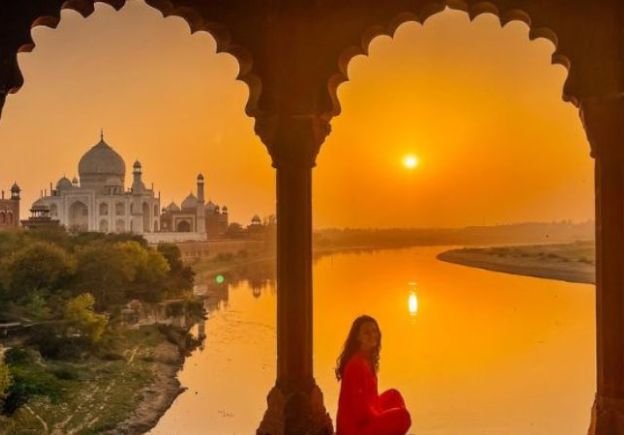
Twilight at the Taj Mahal. As the sun sets, the grounds are cleared of daytime tourists to prepare for the exclusive night viewing batches.
6. Local Warnings & The Infamous Mobile Phone Ban
I cannot stress this enough—security for the ASI night viewing Taj Mahal is incredibly tight, far tighter than daytime entry. Do not bring large bags, food, tobacco, lighters, or anything electronic. However, the most important rule that shocks and devastates tourists every single night is the strict camera policy.
- No Mobile Phones Allowed: Even if they are turned off, even if they are in your deepest pocket, mobile phones are unconditionally not allowed past the gate during the night tour. If you bring one, you will be forced to leave it in the exterior clockroom lockers, which will significantly delay your entry and cut into your 30-minute viewing window. Leave them in your hotel safe.
- No Tripods or Lighting: While standalone professional DSLR and mirrorless cameras are permitted, tripods, monopods, and external flash units are strictly banned. Taking a long-exposure shot handheld in the dark without a tripod is exceedingly difficult. Because you cannot use a tripod to steady the shot, be prepared to push your camera's ISO very high.
- Silence is Golden: Guides are not permitted to give loud lectures during the night viewing. The experience is meant to be serene, quiet, and introspective.
For more official history regarding the conservation of the site and the rules applied to it, you can view the official UNESCO World Heritage center guidelines for the Taj Mahal.
7. Frequently Asked Questions (People Also Ask)
How much is the Taj Mahal night ticket?
The Taj Mahal night viewing ticket costs INR 510 for Indian adult nationals, INR 750 for foreign tourists, and INR 500 for children aged 3-15 years (both Indian and foreign). Children below 3 years of age enter for free.
Is mobile phone allowed inside Taj Mahal at night?
No, mobile phones are strictly prohibited during the Taj Mahal moonlight viewing. You must leave them at the cloakroom. Only traditional still cameras without tripods or extra lenses are allowed inside.
Can we see Taj Mahal clearly on a full moon night?
Yes, provided the sky is clear without fog or heavy clouds. However, you view it from a distance. Visitors are kept near the Red Sandstone platform at the main gate, which is about 300 meters from the main mausoleum. Because artificial lighting is banned, high-quality binoculars are highly recommended for the best, clearest view of the glowing marble.
Can I buy the night tickets on the same day?
No. Tickets must absolutely be purchased exactly one day (24 hours) in advance from the ASI office on Mall Road. Same-day purchases for night viewings are not an option under any circumstances.
Ready for a VIP Agra Experience?
Skip the grueling hassle of waiting at the ASI office. Let our expert local guides handle your offline ticket bookings, queueing, and logistics so you can focus entirely on the magical moonlight.
Book Our Exclusive Night Tours




Leave A Comment